
Right Law Associates provides professional legal assistance in Karachi for husbands and wives dealing with divorce, Khula, dissolution of marriage, maintenance, child custody, dower, dowry articles and related Family Court proceedings.
Divorce and Khula are not identical legal procedures. The correct process depends on whether the marriage is being dissolved by the husband, through delegated authority recorded in the Nikah Nama, by mutual settlement, or through proceedings before the Family Court.
Our divorce and Khula lawyers in Karachi review the Nikah Nama, identity documents, marital circumstances, previous notices and related disputes before advising the client about the appropriate legal course.
Right Law Associates — Karachi Office
M-51, Mezzanine Floor, Muneer Mobile Mall, Block 17, Near Perfume Chowk and Jauhar Chowrangi, Gulistan-e-Jauhar, Karachi
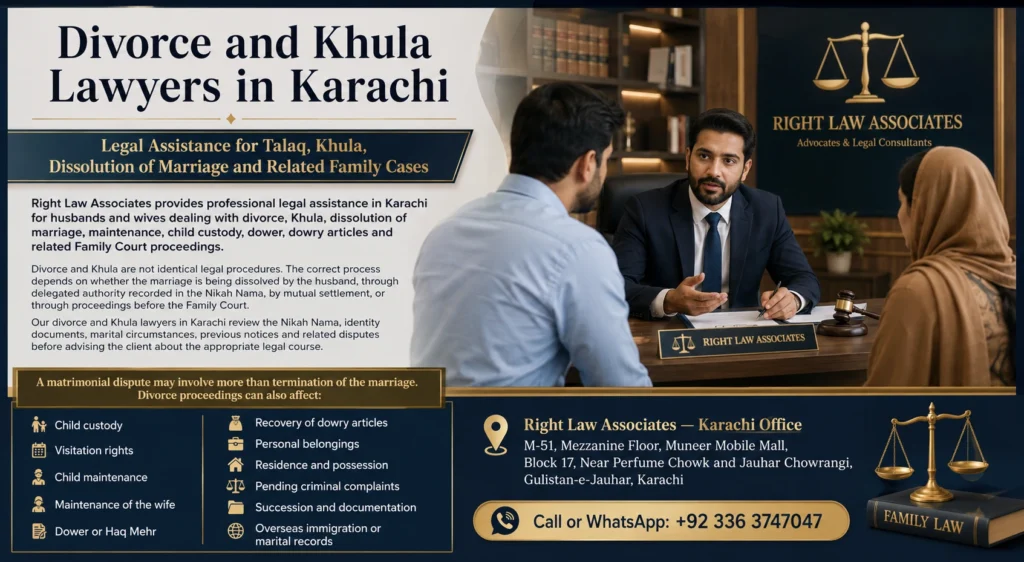
A matrimonial dispute may involve more than termination of the marriage. Divorce proceedings can also affect:
Our divorce lawyers assist clients in understanding which matters can be handled together and which require separate proceedings before the Family Court, Guardian Court, Union Council or another competent authority.
A Muslim husband may exercise his right of Talaq, but the prescribed statutory procedure should follow the pronouncement.
The husband is generally required to provide written notice of Talaq to the Chairman of the relevant Union Council and provide a copy to the wife. The Union Council process includes the prescribed reconciliation procedure before the divorce becomes legally effective.
A verbal pronouncement alone should not be treated as a substitute for proper legal documentation.
Our divorce lawyers in Karachi assist husbands with:
The Muslim Family Laws Ordinance, 1961 principally governs the applicable procedure.
Improperly prepared or unserved divorce documents can create uncertainty concerning:
A properly documented process creates a reliable legal record and reduces the risk of future disagreement.
Khula is a judicial dissolution sought by a wife who no longer wishes to continue the marriage. A Khula petition is filed before the competent Family Court.
Our Khula lawyers in Karachi assist women with:
The legal grounds and available remedies may depend on whether the wife is seeking Khula based on irretrievable breakdown or dissolution on one or more statutory grounds.
The Dissolution of Muslim Marriages Act, 1939 sets out recognised grounds upon which a Muslim woman may seek dissolution of marriage.
The terms “Khula” and “dissolution of marriage” are frequently used interchangeably, but the legal basis may differ.
Khula is ordinarily sought when the wife states that she cannot continue living with the husband within the limits prescribed by Islam and does not wish to remain married.
The question of return or relinquishment of dower may arise depending on the circumstances and basis of the decree.
A wife may seek dissolution on recognised legal grounds, which may include matters such as:
The petition must be drafted according to the facts. Legal grounds should not be inserted mechanically without supporting instructions or evidence.
Although every case depends on its circumstances, a Khula matter generally involves the following stages:
The lawyer reviews the Nikah Nama, CNIC, residence of the parties, marital history, children and any pending proceedings.
The petition is prepared according to the facts, jurisdiction and relief sought.
The case is filed before the competent Family Court in Karachi.
The court issues notice to the husband through the legally prescribed process.
The husband may file a written statement. The court undertakes reconciliation according to the applicable procedure.
Depending on the nature of the case, the court may record statements or evidence.
Where reconciliation fails, and the legal requirements are fulfilled, the Family Court may pass a decree for dissolution.
The decree and related record must be processed properly to complete the applicable Union Council and divorce documentation.
No responsible lawyer should guarantee that every Khula case will finish within a fixed number of days.
The duration may depend on:
A properly prepared petition and correct service information can help prevent avoidable delay.
A husband may participate in the proceedings, contest factual allegations and raise lawful objections. However, the husband’s unwillingness to divorce the wife does not automatically compel her to remain in a marriage that she states she cannot continue.
The Family Court considers the pleadings, reconciliation process and applicable law before deciding the case.
Where both spouses agree to separate, the terms should be documented carefully.
A settlement may address:
An informal settlement should not be relied upon where important financial or child-related rights are involved.
The agreement should clearly state what each party has accepted, returned, relinquished or undertaken to do.
The Nikah Nama should be reviewed to determine whether the husband delegated the right of divorce to the wife.
Where a valid delegated right exists, the legal process may differ from a regular Khula petition. The wording and conditions recorded in the Nikah Nama must be examined before deciding the correct procedure.
A husband living abroad may initiate the Talaq process through properly prepared documents and lawful service arrangements.
Our lawyers assist overseas husbands with:
The documents may require notarisation, consular attestation or other authentication depending on where they are executed and how they will be used.
An overseas wife may be able to initiate or pursue Khula proceedings in Karachi through legally acceptable arrangements, depending on the case.
Our lawyers assist with:
The appropriate procedure should be determined after reviewing the wife’s location, citizenship, documents and ability to participate in the proceedings.
Claims may accompany divorce and Khula proceedings:
Maintenance is determined according to the facts, evidence, financial position of the parties and needs of the claimant or children.
The amount should not be presented as automatically fixed in every case.
Dower is a legal and financial right arising from marriage.
A dispute may concern:
The exact wording of the Nikah Nama is important. Clients should provide a clear copy for legal review.
A wife may seek recovery of dowry articles, bridal gifts and personal belongings where these remain in the possession of the husband or his family.
Useful evidence may include:
The claim should distinguish between dowry articles, personal belongings, gifts and property belonging to another person.
Divorce does not automatically decide permanent custody of children.
Custody and visitation are determined separately according to the welfare and best interests of the child.
Our lawyers assist with:
A parent should avoid using the child as pressure in a matrimonial dispute. Courts focus on the welfare of the child rather than treating custody as a reward or punishment for either parent.
Depending on the case, clients may be asked to provide:
Missing documents do not necessarily prevent an initial consultation. The lawyer can advise which records must be obtained.
Right Law Associates has provided legal services since 1985. Our Karachi family-law team handles divorce and Khula matters through professional consultation, proper drafting and representation before the relevant courts and authorities.
Clients consult our divorce and Khula lawyers for:
No case result is guaranteed. Advice is based on the client’s documents, facts and applicable law.
Lorem ipsum dolor sit amet, consectetur adipiscing elit. Ut elit tellus, luctus nec ullamcorper mattis, pulvinar dapibus leo.
Early legal advice can prevent defective notices, jurisdictional mistakes, incomplete settlements and future disputes about marital status.
Right Law Associates — Karachi Office
M-51, Mezzanine Floor, Muneer Mobile Mall, Block 17, Near Perfume Chowk and Jauhar Chowrangi, Gulistan-e-Jauhar, Karachi
Divorce or Talaq is ordinarily exercised by the husband, subject to the prescribed notice and reconciliation procedure. Khula is ordinarily sought by the wife through the Family Court when she does not wish to continue the marriage.
The prescribed legal procedure requires written notice to the relevant Union Council and a copy to the wife. Proper notice and documentation are important for establishing the legal effectiveness and date of divorce.
The husband’s refusal does not automatically prevent the Family Court from granting Khula. The court follows the applicable reconciliation and judicial process.
The treatment of dower depends on the case, the decree, the wording of the Nikah Nama and whether the claim is based purely on Khula or on separate legal grounds. The documents should be reviewed before advice is given.
Family and custody-related relief may arise from the same matrimonial dispute, but custody and guardianship are determined according to their own legal requirements and the welfare of the child.
Overseas husbands and wives may obtain legal assistance for proceedings connected with Karachi. The appropriate method depends on jurisdiction, documents, authentication and whether personal participation is required.
The statutory process follows the period and reconciliation procedure prescribed by law. The practical completion of documentation may also depend on service, jurisdiction and administrative processing.
A verbal pronouncement should not be treated as a substitute for compliance with the prescribed notice and documentation procedure. Proper legal records are essential for future marital status, inheritance and official purposes.
A wife or child may have maintenance rights depending on the circumstances. The nature, period and amount of maintenance are determined according to the facts and applicable law.
The parties may agree on lawful terms, but the settlement should be documented properly. Child-related arrangements remain subject to the welfare of the child and the jurisdiction of the competent court.
Trusted Legal Solutions in Family, Property, Corporate, and Tax Matters Across Pakistan.
Unified Legal Assistance for Individuals, Families, and Businesses.
Karachi Head Office:
+92 336 3747047
Need free legal advice? Email us. For a paid appointment (PKR 10,000) with S. M. Akhtar Rizvi, Advocate, Supreme Court of Pakistan, get in touch.
© Copyright 2022 Right Law Associates (Pvt) Limited
WhatsApp us