
SINDH EMPLOYMENT LAW · KARACHI
Sindh Domestic Workers Welfare Act: Understand Your Rights and Employment Records
The Sindh Domestic Workers Welfare Act, 2025, enacted as Sindh Act XVIII of 2026, establishes a provincial framework for domestic workers’ employment conditions and welfare. Karachi households and domestic workers should understand the rules on working hours, weekly rest, wages, paid leave, employment letters and complaint procedures.
Whether you employ household staff or work as a domestic worker, clear employment terms and accurate records can help prevent misunderstandings and support a fair resolution when a dispute arises.
Sindh Domestic Workers Welfare Act: What Changed for Karachi?
Sindh Domestic Workers Welfare Act compliance matters to Karachi households employing full-time, part-time or live-in domestic staff and to workers who need to understand pay, working hours, leave and safe complaint procedures. The legislation is titled the Sindh Domestic Workers Welfare Act, 2025, but the Sindh Assembly lists it as Sindh Act XVIII of 2026, passed on 18 May 2026, with an enforcement date of 16 June 2026. It is not a newly enacted November law.
The law supplies a more specific provincial framework for employment conditions and welfare in domestic work. The Sindh Labour Minister’s response to the Provincial Assembly, recorded for the 9 September 2026 sitting and dated 8 September 2026, describes rules on hours, weekly rest, paid leave, maternity protection, wages and a dispute-resolution committee. That parliamentary answer is useful official evidence of how the department explains the law; it should be read alongside the complete Act, applicable rules and later notifications.
For a Karachi family, the immediate task is to replace vague verbal understandings with clear records. For a worker, the immediate task is to know the agreed responsibilities, who employs them, what is owed and how complaints are documented. Neither side should assume that the law automatically decides every disagreement without examining the facts.
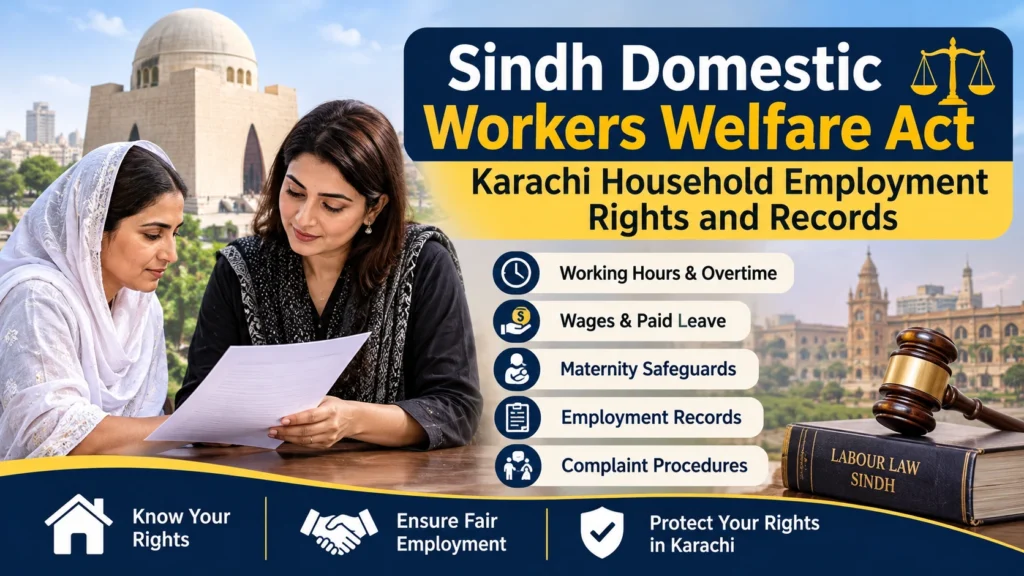
Sindh Domestic Workers Welfare Act: Who May Be Affected?
Domestic work may include cleaning, cooking, household care and other work performed in or for a private household. The Act defines domestic work broadly to include work within or for a household, including childcare, old-age care, sick care and natal or post-natal care. The precise statutory definition and any relevant exceptions should be checked against the worker’s actual arrangement.
sindhlaws.gov.pk
A household worker employed through an agency may raise questions about whether the household, agency or both have relevant legal duties. The Act’s definition of employer includes certain persons or entities exercising control over employment arrangements, including an establishment or agency. The correct position cannot be decided merely from the name appearing on a payment receipt.
The employment arrangement should specify:
Duties and responsibilities.
Working hours and days.
Weekly rest arrangements.
Agreed wages and payment dates.
Leave arrangements.
Accommodation, where relevant.
The identity of the employer and any recruitment agency involved.
In Karachi, even seemingly informal arrangements benefit from a signed or acknowledged statement written in a language both parties understand. An informal family relationship does not justify withholding payment or preventing a worker from leaving safely.
Working Hours, Weekly Rest and Overtime Records
In its September 2026 parliamentary response, Sindh’s Labour Department stated that full-time or live-in domestic workers should not be required to work beyond eight hours daily. It also stated that the maximum working time is restricted to six days a week, with a weekly rest day. If a worker is required to work on the designated seventh day, the employer must pay double the normal wage.
pas.gov.pk
The Act itself provides that a full-time or live-in domestic worker is liable to discharge duties for only eight hours a day. It also states that a full-time, live-in or part-time domestic worker should not be required to work more than six days in a working week, while allowing a mutually agreed seventh day at double the ordinary wage rate.
sindhlaws.gov.pk
Employers should therefore record when work starts and ends, what counts as rest, and whether additional hours are separately compensated. Live-in residence and active working time are not automatically the same thing. Where duties vary between childcare, cooking and overnight presence, obtain advice on the law’s precise application rather than improvising a flat-rate assumption.
Wages, Paid Leave and Maternity Safeguards
The Sindh Assembly’s official response mentions:
Fully paid religious-festival holidays.
Ten casual leave days with full wages each year.
Eight sick leave days with full wages each year.
Six weeks of fully paid maternity leave for female domestic workers.
Protection against wage reduction or termination because of pregnancy or maternity absence.
Payment at not less than the applicable minimum wage notified by Sindh.
The Act also sets out provisions for wages during leave or holidays and says that the applicable payment is to be calculated by reference to the daily average earned during the three months preceding the leave or holiday. Sick leave is subject to a medical certificate from a registered medical practitioner. The Act contains further provisions on maternity payments, including arrangements relevant to workers who are not registered with a relevant institution and the treatment of part-time workers.
These are consequential rights for households and workers. Eligibility, records and applicable implementing details should be checked for the specific case.
The response also refers to minimum wages notified by Sindh. Minimum-wage amounts can change. A Karachi household should check the currently applicable official Sindh notification rather than copying an old newspaper rate into a contract or assuming one flat figure fits all categories and working arrangements. The Act links domestic-worker wages to rates specified by the Government under the Sindh Minimum Wages Act.
What Overseas Pakistanis Should Verify Before Starting
An overseas seller, buyer, heir or authorised representative should first identify whether the particular transaction can proceed through the designated system and whether identity documents are current.
The new Act’s definition of an overseas Pakistani refers to valid NICOP or POC. That should not be confused with an automatic right to execute any property instrument from abroad without appearing or appointing a properly authorised person.
NICOP and Pakistan Origin Card Requirements
For the purpose of the inserted definition, the relevant identity documents are:
National Identity Card for Overseas Pakistanis (NICOP).
Pakistan Origin Card (POC).
The document must be valid and issued by NADRA.
The existence of either document does not remove the need to check other transaction-specific requirements imposed by the competent registration or property authority.
Power of Attorney for Overseas Property Owners
Where a power of attorney is proposed, its text, execution, authentication, permitted powers and acceptance by the competent local authority require separate checks.
The instrument should:
Describe the property and intended transactions clearly.
Identify the representative and the powers being granted.
Avoid uncontrolled sale, withdrawal or onward delegation unless intentionally and lawfully authorised.
Be checked for the execution and authentication requirements applicable to the transaction.
A representative should retain the complete documentary trail rather than relying on a photograph of an unsigned draft shared over messaging applications.
Inherited Property and Overseas Heirs
For families handling inherited land, the title chain may also require estate, heirship, mutation or letter-of-administration analysis.
Those are different issues from where a party’s biometric identity is confirmed.
Karachi property litigation and title review is a separate specialist service for contested ownership, inherited property, cancellation and related civil remedies.
Employment Letters and Receipts Before a Dispute Starts
The Act requires every domestic-worker appointment or employment to be subject to an employment letter in the prescribed form. It also requires the employer to send a copy to the concerned Inspector, manually or through digital means. The Act provided a 60-day period from its commencement for employers to arrange employment letters for domestic workers already employed. The applicable prescribed form and current administrative process should be confirmed before preparing or submitting a document.
A concise employment letter should identify:
The worker and employer.
The relevant household or work address.
Principal duties.
Working schedule and weekly rest.
Agreed wages and payment date.
Leave arrangements.
Accommodation, where relevant.
A lawful method for changing employment terms.
A copy should remain with each party. Avoid clauses that purport to waive mandatory legal safeguards or allow confiscation of personal documents.
Keep payment acknowledgments or bank-transfer records, leave records, working-time notes and significant written instructions. If compensation includes food or lodging, describe it accurately rather than treating non-cash benefits as an automatic replacement for wages. Obtain written agreement when terms change and ensure a worker can access their own documents.
The Act also contains provisions for registration of domestic workers and employers. Employers should verify the current registration procedure and relevant prescribed requirements with the competent department rather than assuming that an informal employment letter alone completes every statutory step.
Common Mistakes in Biometric Property Registration
One recurring error is treating the easiest procedural step as proof of the hardest legal fact.
A valid biometric verification may coexist with a title dispute, an unauthorised power of attorney or an inaccurate property description.
Another mistake is assuming section 38(3) changes territorial jurisdiction over the underlying registration, adjudication or local transfer record.
Its text specifically addresses where biometric verification may be carried out when the specified electronic system is used.
A third mistake is mistaking a private settlement or builder’s possession letter for a registered conveyance.
In Karachi, the property type and the issuing or recording authority are often decisive.
Read the sale document against the full documentary history, and distinguish a contractual promise to convey from an executed and registered interest where registration is required.
When to Seek a Property Lawyer Rather Than a Broker’s Assurance
Get advice promptly if:
A seller refuses to produce prior ownership documents.
The land-owning authority record does not match the deed.
One co-owner is missing.
The consideration is already disputed.
Someone asks for full payment against an unverified instrument.
Where there is imminent transfer to a third party or dispossession, ask about competent-court relief without assuming that a registration-office objection will preserve all civil rights.
Property Legal Assistance in Karachi
Right Law Associates (Pvt) Limited provides property and civil-law assistance in Karachi, including:
Property-document verification.
Agreement review.
Registration-related documentation.
Litigation analysis.
Its publicly stated Karachi legal contact is +92 336 3747047, and services are discussed at the Gulistan-e-Jauhar office by appointment.
The precise professional fee and third-party statutory charges must be supplied in writing for the individual matter; no fixed time or successful outcome is promised here.
Other Employment Safeguards: Accommodation, Health and Termination
The Act addresses additional matters that may be important in a live-in or continuing household employment arrangement:
Accommodation: Where a live-in domestic worker chooses to reside at the place of work, the employer must ensure adequate accommodation and decent living conditions in accordance with the applicable prescribed standards.
Medical examination: The Act provides for annual medical examination by a registered medical practitioner and vaccination or inoculation at prescribed intervals, with relevant expenses borne by the employer.
Termination: Employment termination is subject to one month’s written notice by either the worker or employer, or payment of one month’s wages in lieu of notice, calculated by reference to the average wages earned during the preceding three months.
Wage payment timing: The Act provides that wages must be paid before the expiry of the fifth day after the last day of the wage period. A wage period must not exceed one month. Where the employer terminates employment, earned wages are subject to the separate payment timing stated in the Act.
The precise application of these provisions should be checked against the worker’s circumstances and any applicable rules or notifications.
Domestic Worker Complaint Procedures in Karachi
The Labour Department’s Assembly answer describes a formal Dispute Resolution Committee for workplace grievances, delayed wages or contractual breaches. The Act provides for the Department to constitute such a committee by notification in the official Gazette. It also provides for an Appellate Authority in each district to hear appeals against committee awards.
The Act states that a dispute under the relevant procedure is to be presented within 30 days from the date the dispute arises. A party aggrieved by the committee’s award may appeal within 30 days from the date of that award. The current committee notification, composition, filing procedure and territorial competence should be confirmed before advising a worker to attend a particular office or submit a complaint.
Begin by writing a dated chronology of duties, agreed wages, amounts paid, unpaid balances, leave and communications. Preserve original messages and receipts. An employer receiving a complaint should review records, avoid retaliation and provide a reasoned response. A disputed allegation should not be described publicly as proven abuse or criminal guilt.
Children, Recruitment Agents and Household Safety
The Act prohibits employing a child below sixteen years of age in a household in any capacity. It also restricts domestic work by a person under eighteen to light work that is not likely to harm the child’s health or impede physical or mental development. Families must not treat a young person’s consent, an agent’s promise or a parent’s permission as a substitute for compliance with child-protection law. Verify age through legitimate documentation and do not circulate minors’ identity documents publicly.
Where recruitment agencies participate, clarify who pays the agent, what representations were made and whether fees or deductions are lawful. Threats, physical confinement, violence or immediate danger are not routine payroll disputes; seek appropriate protective assistance from competent authorities.
How Karachi Employers Can Resolve Wage Disputes Responsibly
An employer should calculate pay against dates actually worked, lawful leave and the applicable statutory standards. A worker should identify the unpaid period and produce the strongest available records rather than estimating without explanation. Both should distinguish resignation, termination, a disciplinary allegation and outstanding earned remuneration.
If direct discussion fails, professional review can identify the appropriate labour or civil forum. For broader workplace documentation and employment-law representation, the Karachi employment and industrial-law services at Qanoon House provide a related legal-service route. That page is a private legal-services page, not a Labour Department complaint portal.
Practical Checklist for Karachi Households and Domestic Staff
Before a new arrangement, check the person’s identity responsibly, identify the legal employer, record the services and working time, and confirm a payment method both sides can prove.
Use this practical checklist:
Prepare the required employment letter in the prescribed form.
Confirm the applicable worker and employer registration requirements.
Record duties, working hours and weekly rest.
Confirm wages, payment dates and the applicable minimum-wage notification.
Set out leave and maternity-related arrangements.
Record accommodation arrangements for a live-in worker.
Keep payment receipts, attendance records and leave notes.
Review recruitment-related documents and any deductions.
Do not retain original identity documents indefinitely.
Keep a record of any change to the employment terms.
If a disagreement develops, preserve communications, produce an itemised calculation, and avoid deleting or altering records. A lawful settlement should clearly record what was paid, which issues remain disputed and whether either party needs independent advice. A private settlement cannot validate an unlawful waiver of mandatory rights.
Legal Advice and Karachi Service Coordination
Right Law Associates (Pvt) Limited’s Karachi civil and legal-services team can review employment letters, supporting records and the proper legal forum. The published Karachi office contact on that website is +92 336 3747047; verify current availability before booking.
Legal advice depends on the worker’s status, facts, latest provincial rules and notification history. No outcome or government processing time is guaranteed.
FAQs About Sindh Domestic Workers Welfare Act
FAQs About Sindh Domestic Workers Welfare Act
1. Was this law first introduced in November 2026?
No. The Sindh Assembly identifies it as Sindh Act XVIII of 2026, with an enforcement date of 16 June 2026.
2. Does the law cover every casual household visit?
Not necessarily. Review the statutory definition and the specific employment arrangement before concluding whether the law applies.
3. Can a live-in worker be required to work whenever someone calls?
The Labour Department’s stated eight-hour and weekly-rest framework makes unlimited working hours unsafe to assume. The precise application should be considered against the Act and the worker’s actual duties.
4. Is a written contract compulsory for every arrangement?
The Act requires an employment letter in the prescribed form for domestic-worker employment. Confirm the applicable rules and prescribed process. A clear written record is advisable even where employment began verbally.
5. Are festival holidays automatically unpaid?
No. The provincial Assembly response identifies paid religious-holiday leave, subject to the law’s application.
6. Can an employer dismiss a worker simply for becoming pregnant?
The official departmental response describes maternity protections against wage reduction and termination because of pregnancy or maternity absence.
7. Is there one permanent minimum wage for domestic staff?
No reliable article should assume that. Check current Sindh notifications and the legally applicable category before relying on a wage figure.
8. Can children under sixteen be hired for household work?
The Act prohibits employing a child below sixteen in a household. It also restricts domestic work by persons under eighteen to qualifying light work. Families should verify age and comply with child-protection requirements.
9. Does a text-message complaint automatically prove unpaid wages?
No. It may be relevant evidence, but dates, payment records and the underlying agreement still require evaluation.
10. Where should a worker submit a complaint?
Confirm the current competent provincial mechanism and jurisdiction, including whether the relevant Dispute Resolution Committee has been constituted by notification, before filing.
Need Help Reviewing a Domestic Employment Agreement or Wage Dispute in Karachi?
The Sindh Domestic Workers Welfare Act establishes important requirements concerning employment letters, working hours, weekly rest, wages, leave and dispute resolution. Whether you are a household employer or a domestic worker, understanding the applicable provisions and maintaining accurate records can help you take a more informed next step.
Right Law Associates (Pvt) Limited can review relevant employment documents, payment records and the legal issues involved, and help assess the appropriate legal route based on the facts and applicable law.
Verify current office availability before booking. Legal advice depends on the individual facts and applicable law. No legal outcome or government processing time is guaranteed.